
1
Mat on the floor, toys out, you sitting close.
Sessions that look like play, because that is how children learn movement. You stay in the room, and you leave knowing exactly what to practice before next week.
What It Is
Somebody probably told you to give it time. That children grow out of things. Sometimes they do, and you were right to hope so. You know your child better than anyone, which is why you are still reading.
Here is the part that is harder to see. A child who avoids a movement gets very good at avoiding it. The strong side takes over. The habit sets while the body is still growing, and growth builds on whatever pattern is already there.
Pediatric physical therapy checks whether there is something to work on, and if there is, works on it now, through play. Tummy time a baby will actually tolerate. A game that happens to load the weaker leg. With torticollis, cerebral palsy or a delayed milestone, the goal is never that your child is fixed, because that is not the honest word. The goal is strength, control and joining in, on your child’s own timeline.
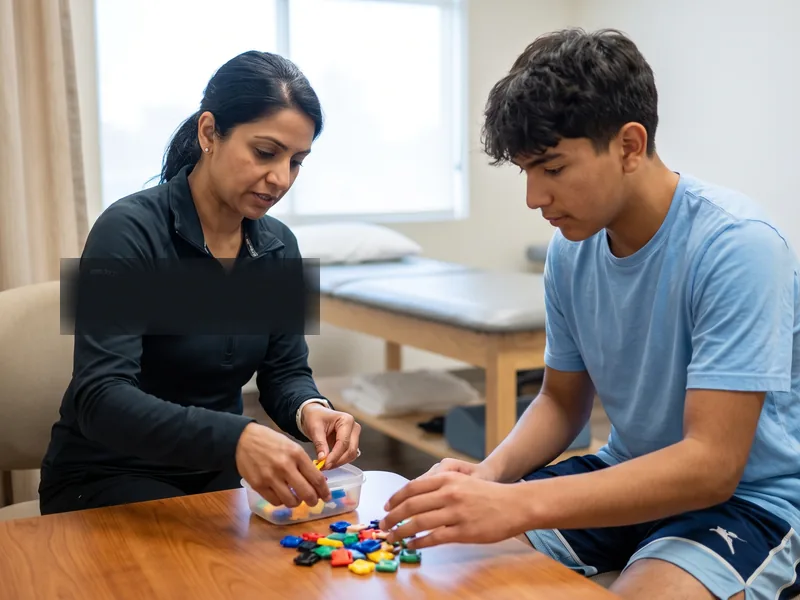 You stay in the room, always
What It Helps
Children are not small adults. They need a session that looks like play and a parent who knows what to practice.
What A Session Looks Like
1
Mat on the floor, toys out, you sitting close.
2
The hard movement, hidden inside the game.
3
You try it yourself before you leave.
Why It Works
A milestone reached, then held.
The weaker side pulling its weight.
Joining in at the playground.
A parent who knows exactly what to practice.
Pairs Well With
Questions, Answered
Most children don’t, at first, and the session is built for that. The work is hidden inside a game your child actually wants to win, so cooperation is earned rather than demanded. Crying is allowed. Bad days are allowed. If your child shuts down, we change the activity instead of pushing through it, and what happened still tells us something useful.
Yes. You stay in the room for every session, and you are part of it. You know what your child does at home, which is information nobody else in the building has. You are also the one practicing between visits, so you learn the movement here, with your hands on your child and your therapist watching. It is one-on-one with a Doctor of Physical Therapy, every visit, and the same clinician sees you each time.
Because it gets measured and told to you plainly. At the start we write down what your child can do right now: how long a position is held, which way the head turns, what happens without help. Then we reassess at set intervals and compare it against that. Children do not develop on a schedule, so we will not promise you weeks. We will always give you a clear answer about what is changing and what is not. Want to talk it through first? Call us at (973) 453-0488.
Book Your Visit
Request a time and a real person calls you back, usually within one business day. No phone tree. No ‘someone will reach out.’ Just a plan.
5.0 · 33 Google reviews
Typical response: within one business day
Step 1 of 5
That’s the hard part done. We’ll call during business hours to lock in your time and find you the earliest one that works.
Visit Us