
From visit one
Pain
Take the fight out of moving.
Here this phase is mostly rigidity, aching from a posture held too long, and fatigue. Hands-on work and better positioning make the next hour cost you less.
What We Treat
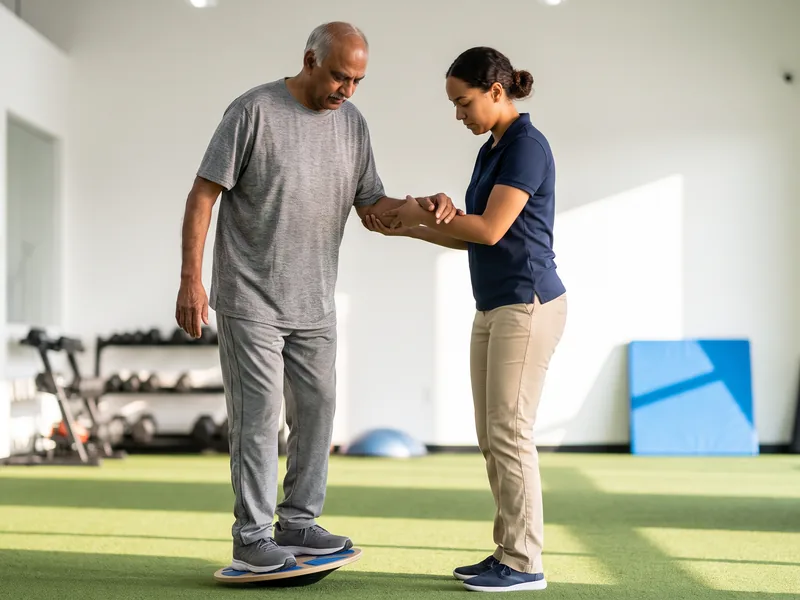
Feet that hesitate at doorways and a walk that keeps getting smaller. Parkinson’s does not stop, but balance, strength and confidence are all still trainable.
Sound Familiar?
You’ve been the steady one for decades. Getting help with your balance isn’t losing that. It’s how you keep it.
Why It Happens
Parkinson’s affects the part of the brain that sets the size and the timing of movement. The muscle still works. The volume dial got turned down. That is why a step shortens, an arm stops swinging, handwriting shrinks and a turn breaks into little shuffles. Your brain believes it is making a normal-sized movement. It isn’t, and it has stopped noticing the difference.
So this is a retraining problem, not a resting problem. Two things reliably move the needle: deliberately oversized movement, practiced at a dose high enough to stick, and external cues that bypass the faulty internal timer, a count, a rhythm, a target on the floor. Rest does the opposite. It lets the small pattern become the only pattern, and takes strength and stamina with it. Parkinson’s is progressive, and physical therapy does not change that. What it changes is how well you move while you live with it.
The Honest Truth
Nobody regrets starting too early. Plenty of people regret waiting.
How The Plan Works
Nothing here stops Parkinson’s. Here’s what Pain, Prime, Perform and Prevent do instead: better balance, fewer falls, and independence you hold on to for longer.
From visit one
Pain
Here this phase is mostly rigidity, aching from a posture held too long, and fatigue. Hands-on work and better positioning make the next hour cost you less.
As stiffness eases
Prime
Amplitude and mobility work reclaim the range Parkinson’s quietly shrinks: trunk rotation, arm swing, a step that lands where you aimed it.
As strength builds
Perform
This is the engine. Large, specific movement practiced often enough and hard enough to stick, plus cueing you can actually use when your feet stall at a doorway.
Ongoing
Prevent
Balance and fall prevention work, a home program built to be kept, and honest goals: fewer falls, more stamina, and holding your ground for longer.
Extremely happy with physical therapy received at 10 on 10 after hip replacement. I can tell that I’m getting stronger after each session.
Shared by Roberta S. · Hip replacement
Questions, Answered
No, and the reason is mechanical rather than motivational. What produces change here is deliberate, well-dosed, repeated practice, and that is available at any stage of the condition. What years change is where you begin: a smaller walking pattern has had longer to become your default, so more of the early work goes into undoing that before bigger movement will hold. Your evaluation tells you what you have to work with now, and what it will take.
Fatigue is part of Parkinson’s, so it gets planned for rather than ignored. Sessions are timed around your good hours and built on how much you can repeat well, not on how hard you can go once. Effort can make tremor or stiffness louder for a while without meaning damage, and that difference gets explained to you as it happens. You work one-on-one with a Doctor of Physical Therapy, every visit, so the dose is adjusted in the room instead of guessed at home.
It does not stop the disease, and no honest clinic will tell you otherwise. What practice changes is your function: step length, balance, strength, stamina, and how often you end up on the floor. That is the real promise here, better movement and independence held for longer. Dr. Namrata Agarwal has fourteen years of hands-on patient care across outpatient, acute care and skilled nursing settings, with neurological conditions and balance and fall prevention among her specialties, and she has treated Parkinson’s. At each reassessment you get a straight answer about what is working.
Book Your Visit
Request a time and a real person calls you back, usually within one business day. No phone tree. No ‘someone will reach out.’ Just a plan.
5.0 · 33 Google reviews
Typical response: within one business day
Step 1 of 5
That’s the hard part done. We’ll call during business hours to lock in your time and find you the earliest one that works.
Visit Us