
Weeks 1–2
Pain
Calm the pain down.
Hands-on work on the stiff upper-neck joints and overworked muscles eases the ache and the headaches that ride along with it.
What We Treat
The knot between your shoulder blades by 3pm, and the headache that arrives with it. We look at what your neck has been compensating for, not just the spot that hurts.
Sound Familiar?
Two or more? You’ve been pushing through it because everyone else needs you upright. It’s worth fixing properly.
Why It Happens
Your neck doesn’t hurt for no reason. And it’s rarely one thing. Usually it’s a mix: joints in the upper neck that stiffened and stopped sharing the load. A disc or nerve root getting crowded. Deep neck and shoulder-blade muscles that gave up and handed the job to the ones on top. And a head that sits a little forward all day, which your neck has to hold up for every one of those hours.
Which is why the sore spot is usually not the cause. That knot you keep digging into is often a muscle working overtime for a stiff joint below it, or a shoulder blade that isn’t doing its share. Rub the knot and it’s back by Thursday. A cause-first evaluation finds the link that’s actually failing, and that’s where the work goes.
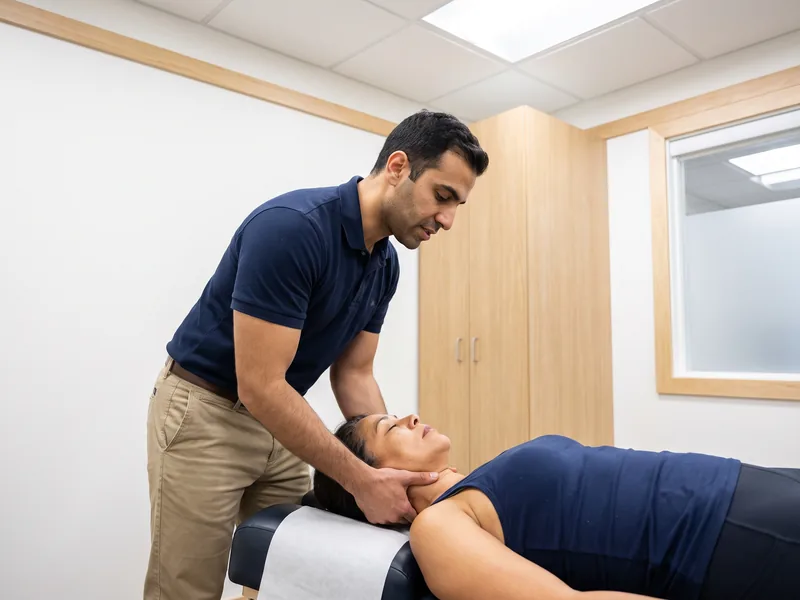
The Honest Truth
Nobody regrets starting too early. Plenty of people regret waiting.
How We Fix It
Every plan has an endpoint. Here’s what the four phases look like for a neck that hurts to turn.
Weeks 1–2
Pain
Hands-on work on the stiff upper-neck joints and overworked muscles eases the ache and the headaches that ride along with it.
Weeks 2–6
Prime
Rotation and side bending come back segment by segment, so checking your blind spot stops being a decision.
Weeks 6–10
Perform
The deep neck muscles and shoulder blades get strong enough to hold your head up through a full day, without the top muscles rescuing them.
Weeks 10+
Prevent
Your desk setup, your pillow, and your screen habits get sorted so the same strain stops rebuilding. That’s the endpoint, not another appointment.
From the moment I walked through the door, Namrata Agarwal made me feel welcomed, heard, and genuinely cared for. Her depth of knowledge and clinical expertise is immediately evident, but what truly sets her apart is how she combines that professionalism with an incredibly warm, encouraging, and patient approach.
Shared by Mohan S. · Neck pain
Questions, Answered
Usually not, and it’s rarely the right first step. Most neck pain improves without imaging. Scans routinely show disc changes and wear and tear in people who have no pain at all, so a picture doesn’t always name the cause. Your evaluation is hands-on instead: we test how each segment turns, how your shoulder blades behave, and whether a nerve is involved. If imaging becomes genuinely necessary, we’ll help you get it. Waiting on a scan mostly costs you time you could have spent getting better.
In most cases yes, and gentle movement helps more than a collar or full rest. Hurt does not always mean harm. A neck that stops moving gets stiffer, and the muscles holding your head up get weaker while it waits. What matters is dose and direction. Some movements settle an irritated nerve, and others light it up. Sorting out which is which is the whole job, and you do it one-on-one with a Doctor of Physical Therapy, every visit.
Many people feel meaningful change within the first four to six visits. A full plan works through all four phases, Pain, Prime, Perform, and Prevent, and how long that runs depends on how long your neck has been like this. Either way you get a plan with an endpoint. You’ll always know which phase you’re in and what’s left, instead of an open-ended string of appointments. And you spend it one-on-one with a Doctor of Physical Therapy, every visit.
Book Your Visit
Request a time and a real person calls you back, usually within one business day. No phone tree. No ‘someone will reach out.’ Just a plan.
5.0 · 33 Google reviews
Typical response: within one business day
Step 1 of 5
That’s the hard part done. We’ll call during business hours to lock in your time and find you the earliest one that works.
Visit Us